Author: Moira Devlin

  • Power of Self-reflection

    Power of Self-reflection

    What are the benefits of self-reflection?

    Self-reflection is something we often view as a personality trait. It is all about how we control our own behaviour to succeed. The truth of the matter is some people are better at this than others, however, that doesn’t mean it is not possible for the rest of us. 

    Those who are more natural in self-reflection respond to their environment. It comes down to setting up routines and consistency of approach by making it a habit.

    Good habits are worth being fanatical about.

    John Irving 1

    To develop a structure around your own self-reflection, you need to step into that unknown. We are all more comfortable when we are familiar with a situation, but the only way to improve anything is by taking a risk. 

    Balancing our risks and rewards against our goals means we are more likely to succeed. It is all very well setting out detailed goals but risks and rewards set our boundaries for a good job done. Self-reflection tells us if we are on track and doing the best job.

    What is Self-Reflection?

    Self-reflection can lead us to a happy and fulfilled life. It can protect our mental and emotional wellness, too. 

    It’s the key to elevating our life. Self-reflection involves examining our memories, our feelings, and our thoughts and taking the time necessary to understand and analyse them to our benefit. 

    It is not just about our thoughts, though, it also encompasses our behaviour. We reflect on previous thoughts and events and take the lessons to improve ourselves and do better next time. 

    This needs to be a habit, it’s a skill, so we can learn it. It’s never too late to start and we can develop our self-reflection skills now. 

    This will help us to realise our talent, our passions, and our focus. It is the most efficient way to elevate our career.

    Self-reflection brings:

    • Ability to think more clearly and set defined goals.
    • Spending more time with ourselves means more tuned in to our internal compass. 
    • Less likely to repeat negative and destructive patterns. 
    • Less likely to self-sabotage. 
    • Feel energised about our career path. 
    • Feel more content. 
    • Embrace our career vision. 
    • Get in touch with our why and start living it.
    • Our relationships, with ourselves and others will improve. 

    So, how can we get started with the habit of self-reflection?Perhaps the best way to start would be in writing our thoughts or creating mind maps. 

    Then we can look back on our thoughts. Or keep a journal, meditate or take long walks every evening. Experiment with different things to find what works for you personally.

    Experimenting in different approaches is part of the discovery process, and it can be fun.

    Confidence check-in

    There are a few things we can do to keep our confidence in a good place. A good starting point is for us to take a small amount of time each day to spend in self-reflection. During this time, we analyse our thoughts and actions by asking the following questions: 

    • Did you exude confidence or arrogance? 
    • Were you confident in your personal ability to complete a task? 
    • Did you believe you were the only one capable of completing a task? 
    • Do people seem put off or bothered by you behaviours? 
    • Do people seem positive or encouraged by you behaviours?

    We should be vigilant and always pay attention to how others act around us, and how they react to things we do. 

    Being aware of our surroundings and reading people effectively keeps us in touch with our environment.

    Nurturing and growing our confidence means looking in the mirror to understand how positive we are and how we need to use our purpose and self-reflection to protect and grow our confidence.

    If we do nothing else, building our confidence will provide a bedrock to our career success.

    Confidence Snapshot. 

    Complete this short questionnaire by selecting one option for each statement below:
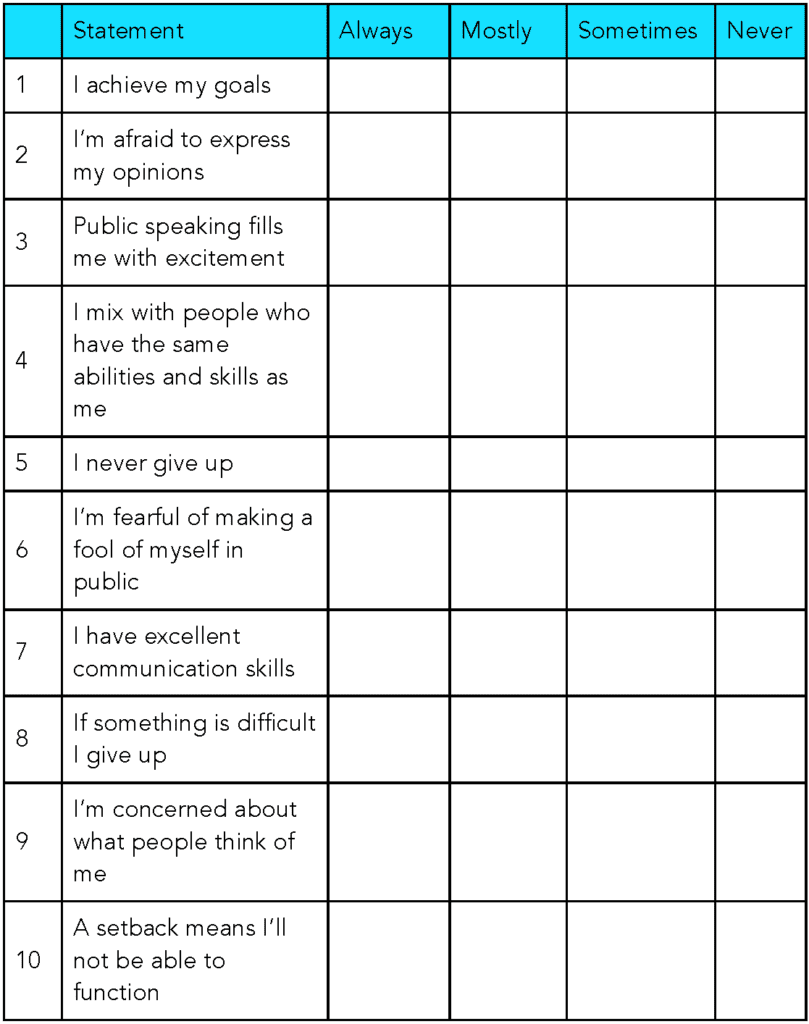
    Then create this next table and circle each choice in the table. 
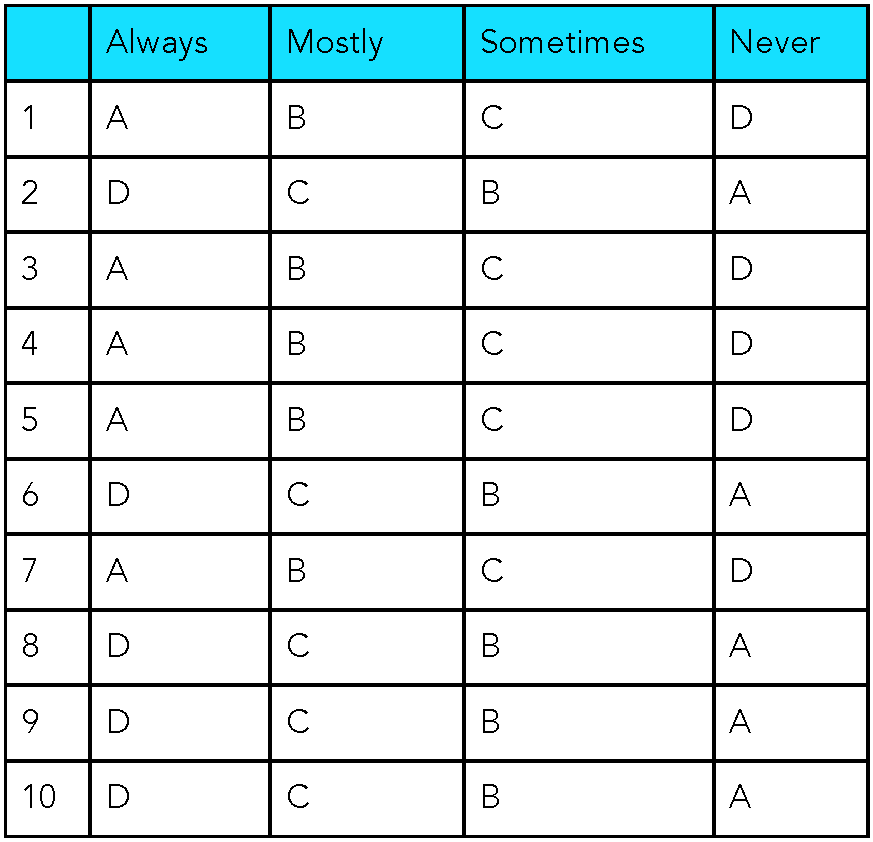
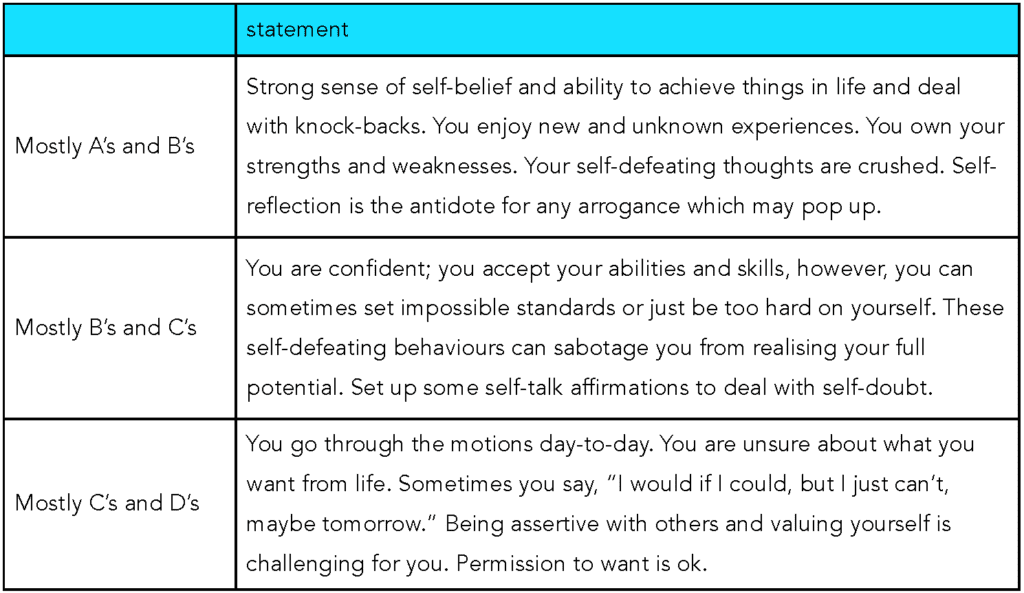
    Lastly, total the number of A’s, B’s, C’s and D’s. Then review summary feedback.
    References:

    1. John Irving (1942-) American-Canadian author and screenwriter.

    © 2022 Lifexpression Limited All Rights Reserved 

    © 2022 Shutterstock.com. © 2022 Envato Pty Limited

  • Workplace Change Challenge

    Workplace Change Challenge

    How do you prepare for workplace change?

    For sure, change is unceasing in your career and in the workplace.

    In the main, organisational change is concerned with people, processes and technology.

    Organisations are continually developing. They are under pressure to compete and be prosperous on an infinite loop. 

    Change in the workplace is frequent. Be it expansion, cost savings, productivity drives, restructuring, adhering to new laws, exploring new ideas or technological advancement.

    Change equals growth and survival for organisations. But how good at change is an organisation? Some research tells us not very good with an eye-watering failure rate.

    a failure rate of around 70 per cent of all change programmes initiated.

    1

    Maybe this should not be shocking. Organisations comprise of people and people just do not appreciate change. People prefer to maintain the status quo, even if the change is positive.

    When faced with a workplace change, what is your first thought? It means uncertainty and disruption to routines.

    Our Animal Instinct

    We are hard-wired to suspect change, even to see it as a threat. Part of the brain, the amygdala, reads change as a threat and releases the hormones for fight, flight or freeze. Your body reacts to change by sensing it needs to defend you from it!

    We evolved to strive to plan, control and predict our many life circumstances. For example, we associate routines with survival. 

    On a basic level, we need to eat, exercise, and sleep regularly to survive.So when people including senior leaders are presented with something new they will resist it. Even if it is a change that will pay off.

    Often, we identify organisational change with stress because we react when we feel threatened. It happens when we are in a situation we feel we cannot manage or control.

    So what should you resolve to do when faced with workplace change? 

    An important starting point for dealing with change is to assess your current state and your future state. Ask yourself what the change means to you, your routines, and what you can influence or control.

    Managing Change

    How can you turn change from a threat into an opportunity? There are many change theories to consider. We can consider Lewin (2) to be the patriarch of change management. His iterative model focuses on the personal conditions of change.

    Change is the physical condition, and the transition is our inner psychological experience.

    In stage one, we scrutinise our keenness to change. Force Field Analysis tells us if the driving force exceeds the restraining force.

    Stage two is where transition happens, with stage three helping us to discover the purpose of making the change final.

    Lewin’s Force Field Analysis is an authoritative key tool adopted to interpret what is needed for change at an organisational and personal level. Analyse the positive (driving) and the negative (restraining) forces which affect a change moving from the current state to the future state.

    Determining the driving and restraining forces means we can assess which ones are most critical. Then we take the steps to increase driving forces and reduce the critical hindering forces.

    Lewin’s theory is an effective structure to apply to any change. 

    If you apply a structured approach to managing change, it can mean less stress and a healthier and happier outcome.

    References:

    1 – By, Rune. (2005). Organizational Change Management: A Critical Review. Journal of Change Management. 5. 369-380. 10.1080/14697010500359250. 

    2- Lewin, Kurt (1947). “Frontiers in Group Dynamics: Concept, Method and Reality in Social Science; Social Equilibria and Social Change”. Human Relations. 1: 5–41.

    2- Lewin, Kurt (1948) Resolving Social conflicts, Harper & Brothers

    © 2022 Lifexpression Limited Limited All Rights Reserved 

    © 2022 Shutterstock.com. © 2022 Envato Pty Limited

  • The Future Today

    The Future Today

    Are you ready for Brave New World Inc?

    The world of work was tinkering with 4th Industrial and Agricultural Revolutions. Then the Pandemic came along. 

    Not only did it shake the global trees of businesses and governments, it exposed the fragility of many economies and laid bare the copious injustices in our global society. 

    There are many opposing views on how the global society is judged. What moment is its defining  moment in history? Is it still to be determined?

    In the meantime, many people are dealing with the challenge of finding a career in this Brave New World Inc (“BNW Inc”), which hasn’t even written its vision or mission statements yet! 

    Blind-sided 

    BNW Inc is throwing up some unique challenges for career development.

     85% of the jobs that will exist in 2030 haven’t even been invented yet.

    1

    The traditional business structure is disappearing due to flatter structures, acquisitions, outsourcing and growth of entrepreneurs. 

    We expect robots to have a tremendous impact, but so far it isn’t clear what that looks like. 

    As the technological advancements and the solutions are so interconnected and fast-moving, no one business will have all the answers.

    Learning in realtime

    It is expected you will learn in the moment and have the skills and resilience to cope with constant demand of shifting skills sets. So how can you survive this new challenge? 

    When you are up against it, it is your relationship and communication skills that will assist you to find solutions and dare you to embrace change. 

    Usually you build this overtime, but you will have to press the fast-forward button and get them now.

    65% of children entering primary school today will ultimately end up working in completely new job types that don’t yet exist. 

    2

    New opportunities

    BNW Inc is racing ahead assisted by the Pandemic. This challenge isn’t just for Gen Alpha any longer, Gen Z and Millennials will be affected too. 

    So, can you predict what skills you will need for unknown jobs? 

    Some research 3 tells us it is safe to assume that, as a prerequisite, higher order thinking skills are key combined with soft skills.

    For many twenty-first century school leavers, the journey from school to the workforce is taking longer and becoming more precarious.

    4

    It is a Revolution like no other.

    Not only will you have to develop skills at short notice, but society has not prepared you for BNW Inc. 

    Even although everyone being affected relative to individual circumstances. Is the change so profound that educators could not capture your future job training needs? 

    Educators like business don’t seem to have all the answers. So is it time for a further shift of the Global Village? 5 . If so, maybe you can expect a spirit of co-creation and collaboration with business to find solutions.

    On the surface it can make your brain hurt preparing for future job skills requirements, but it is key to giving you a competitive edge. 

    The good news is as the global trees shake you can be ready to catch and co-create the career opportunities.

    References:

    1 – Dell technologies, Institute For The Future ( 2018)

    2 – Scott McLeod and Karl Fisch, “Shift Happens” (2007)

    3 – World Economic Forum The Future of Jobs Report (2018)

    4 – Mitchell Institute Report preparing young people for the Future of work Kate Torii and Megan O’Connell (2017)

    5 – Marshall McLuham (1967) “The Gutenberg Galaxy: The Making of Typographic Man” (1962) “Understanding Media” (1964); Marshall McLuhan  and Barrington Nevitt, The Executive as Dropout (1972); Marshall McLuham and   Bruce R. Powers (1989) The Global Village: Transformations in World Life and Media in the 21st Century.

    © 2022 Lifexpression Limited All Rights Reserved 

    © 2022 Shutterstock.com. © 2022 Envato Pty Limited

  • Making of a Leader

    Making of a Leader

    What does Leadership mean?

    Leadership is the competence to influence and/or persuade others to perform tasks or complete activities.

    Leadership is the capacity to translate vision into reality.

    1.

    Old Power

    But have we always explained leadership this way? Prior to 1800s CE, the notion of leadership was regarded with classical deference and acquiescence to rulers, tyrants, monarchs, and even slave-masters. Coupled with poor life expectancy, daily life for most of us meant enduring the drudgery of survival under oppression.

    From this point forward, the development of democracy and human rights grew and strengthened. Still a choppy erratic ride for the world, but the inroads democracy has made have changed how we perceive leadership and how we see it working. 

    In many countries, ordinary humans received fundamental freedom of speech, movement and the right to vote in fair and free elections. Diminished was the power of the rich landowners and royalty who saw it as their god-given right to rule without reference to the ‘masses’. 

    They deemed to be in charge and lead was a privilege, not a right, but they were then faced with those ordinary humans having expectations of freedom, justice and equality in society. 

    Seismic events like the French Revolution, the American Revolution, and the Industrial Revolution led to a growth of Trade Unions and suffrage for ordinary men and women combined with the appearance of business owners and entrepreneurs generating their own money through ingenuity and business prowess. Thus lessening the leadership of privilege.

    Ordinary Democracy

    During this period of several hundred years, democratisation was a slow, imperfect process. Today, in observing the world, it is still an inconsistent, flawed and slow journey to common democracy across the world. Leadership of today reflects this journey. We may consider someone a leader because of a formal relationship, through rank – money, managerial position or royal heritage. Or instead, a leader can be informal, someone who steps up and provides guidance from within a group, not the person who has authority. Or a leader can earn their ‘stripes’ by leading through distinguished example. 

    Although talked and written about, we describe leadership as one of the least understood concepts across all cultures. The contemporary leadership concept is new. Many leadership theories discuss the different leadership styles or types and the best qualities associated with leadership.

    Historically, leadership was about power over others and, to some extent, this is still true today. However, nowadays, it can be with a healthy dose of democracy thrown in! 

    Organisations reflect society and to grow, develop, even survive, they have had to become more democratic. This has affected leadership styles. Though autocratic styles still exist, there is a whole plethora of leadership theories telling us what a good and/or successful leader profile is today.

    How do leaders get to lead today? Research tells us that nowadays, on the whole, although leadership is certainly about power, power does not always get to “lord it” over people. Rather, it is a power with the people that exists as a reciprocal relationship between a leader and his/her followers. 2 

    Also, measuring leadership has proven difficult, even impossible. Different perceptions of leadership may lead to various measuring methods. Leadership theories continue with a reluctance to abandon vague, subjective popular concepts of ‘leaders’. 3

    We may be link this to the idea of leaders as heroes popularised in the mainstream narrative of histories, stories, movies and books.  There are examples where hero can be justified, e.g., when faced with extreme events, like a war. Those leaders stepping up to deliver do indeed become heroes.

    Maybe leadership is about discovering the leading theories and tools to go about setting the best example to others and determining your inner hero.

    References:

    1. Warren Gamaliel Bennis (1925 – 2014) American scholar, consultant,  author,.
    2. Forsyth, D. R. (2009). Group dynamics (5th ed.). Pacific Grove, California: Brooks/Cole.
    3. Gardner, J. W. (1965). Self-Renewal: The Individual and the Innovative Society. New York: Harper and Row.       Bennis, W. G. (1975). Where have all the leaders gone? Washington, D.C.: Federal Executive Institute.

    © 2022 Lifexpression Limited All Rights Reserved 

    © 2022 Shutterstock.com. © 2022 Envato Pty Limited

  • How To Be More Creative

    How To Be More Creative

    What is a creative frame of mind?

    So how do you go about getting more creative? Let me give you some ideas.

    Find the right frame of mind

    Explore what states you associate with feeling creative. Discover what triggers and maintains your creativity. 

    Ask yourself:

    • What is your best time of day? 
    • The best environment? 
    • Do you need to be alone or with others or alone amid others? 
    • Do you need sounds or silence or background music? 

    Build a profile of your creativity state. Instead of waiting for some divine intervention or for it to just happen on its own make time and space for using this state regularly.

    Cultivate dreaming

    Pay attention to your experience of life and attention to your existing creativity rather than dismissing daydreams, intuitive feelings and dreams. 

    Do not allow yourself to waste what you may already discover by ignoring it. Ask yourself “What if?” and “What else?” and “How else?” 

    What if you were born a different race or gender?

    What if you were born in a different part of the world?

    What if non-human animals could talk?

    Always go beyond your first thought in order to find more and more fresh ideas.

    Creativity is a habit, and the best creativity is the result of good work habits.

    Twyla Tharp 1

    Do something different 

    If you hit a problem, pretend your usual solution is not available. For example, if your laptop crashes today, how else might you do your work? 

    See how different results you can get by using the same three ingredients to cook as many meals as possible. Do not limit yourself.

    Then challenge yourself with cooking everything in one pot.

    If cooking is not your thing, you can have some great fun by taking an every day object and 

    imagine or think about how many other uses it can have

    You can even think about how to combine them with other objects. These will develop and enhance your creativity.

    Think of different ways to do the familiar with everything around you.

    Change the order in which you do things, use different things, eg, use your less favoured hand to write, to draw.

    As soon as you break routine, you move from a state where you are on auto-pilot to one where you are alive and alert. You exercise unfamiliar brain connections and build new links in your brain too. A glorious feeling!

    Look out for what makes a difference. When you encounter something that strikes you as different, ask yourself what it is about it that is so different or unusual. As yourself “Where does the key difference lie?”

    Experiment with your creative skills like writing in a journal or blog just for fun. Or create a test or quiz from scratch on a subject you find interested. 

    Brainstorm project ideas at work or at home, for example, garden design, home renovations. Even consider processes and procedures, which can improve any product or service you use. 

    There are endless ways to use your creativity everyday.

    References:

    1.Twyla Tharp (1941-)American dancer, choreographer, and author

    © 2022 Lifexpression Limited All Rights Reserved 

    © 2022 Shutterstock.com. © 2022 Envato Pty Limited

  • Holding Back Creativity

    Holding Back Creativity

    What are Creative Frustrations?

    Before thinking about how to be creative, let us begin by pointing out some real barriers some people seem to have when wanting to enhance their creativity. 

    • “I’m just not creative.”
    • “I don’t like the idea of getting it wrong.” 
    • “I don’t have the time.”
    • “Fantasising about stuff is a waste of time.”
    • “Logic and reason is the answer.”

    Creativity is about producing ideas. It only takes seconds to link our thoughts and ideas. It can happen anytime, anywhere. 

    Provided you are in the right state of mind and pay attention to your own experiences.

    Rational thoughts never drive people’s creativity the way emotions do.

    Neil deGrasse Tyson 1

    The quality of your creativity improves when you are receptive to your feelings and thoughts.

    Self-esteem check-in

    Creativity results in unusual ideas and perhaps even being different. We can think of many ideas as strange or challenging. 

    Fear of being weird, stupid or just different often kills creativity. If a creative person feared any of those things, they would never create anything! When you do something creative, you go beyond the bounds of feeling safe and leave the familiar in the past.

    When you are not sure about yourself, being different in any way can feel risky or make you feel vulnerable. The danger is you give up your new ideas to just blend in.

    This inhibits us. If you are making a new connection in your brain, there can be no inherent ‘right’ or ‘wrong’ about it.

    Failure can only have two meanings. Firstly, something didn’t work out the way you wanted it to. Secondly, someone else did not like it. But so what??!! Many inventions start out as failures. 

    It’s a Bubble Wrap

    Bubble wrap was supposed to be a fashionable new 3 D textured wallpaper for the 1960’s. It was a total flop until the inventors (Fielding & Chavannes) found a new use for their invention. 

    They had to wait until IBM needed something to protect its computers from being damaged during shipment.

    Sealed Air was established and this great invention has grown to a become a multi billion company. 

    Where would we be without bubble wrap? For both packaging and popping!! 2,3,4, 5,6.

    Failure is fine because it feeds back into the creative process much like an inspiration. 

    Creative techniques such as brainstorming enhance your creativity. If at any time you doubt your ability to be creative, remind yourself several times every night you create an entirely new dream, which you script, act in and watch

    It involves all your senses and has effects that can last long after it is over. 

    When in doubt think of the bubble wrap journey! 

    This creation appears so very effortless many people do not even recognise its bumpy ride to creative success!

    References:

    1.Neil deGrasse Tyson (1958-)American astrophysicist and author.

    2.Petch, Michael (2019). “The hype and rise of 3D printing and Avi Reichental”. 3DPrintingIndustry.com.

    3.”Has bubble wrap become a generic trademark?”. genericides.org. (2021)

    4.”Bubble Film and Bags”. Packaging Knowledge. Retrieved September 28, 2010.

    5. Fielding & Chavannes patent example 

    “Method for Making Laminated Cushioning Material,” patented July 28, 1964 U.S. Pat. No. 3,142,599

    6. Burke, Monte (2006). “Wrap Star”. Forbes.

    © 2022 Lifexpression Limited All Rights Reserved 

    © 2022 Shutterstock.com. © 2022 Envato Pty Limited